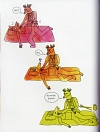
DIARY #3, GROWING UP PRINT, TCAF IN EFFECT

Brand new and debuting at this weekend’s Toronto Comic Arts Festival! Diary Comics #3, published by Koyama Press! 88 pages of comics, this mother is FAT, barely contained by it’s bellyband/girdle. Full color covers with French flaps, double-stapled guts printed in crisp black and white. Hand-assembled by yours truly, this book represents an insane amount of work, but I think it was worth it. I’m often publicly dismissive of my own diary comics, but this volume is where they start edging into stronger territory, both in terms of the art and the occasional forays into territory besides depression or minutiae. I’m about to start doing diary comics more regularly again, expanding on this direction, and I’m very excited about this book, not to mention thankful to Anne Koyama for publishing it!

The book will debut at TCAF this Saturday and Sunday, but if you’re not going, you can preorder it now.  It’s $10 USD for the regular edition, or $15 for a sketched edition (quantities limited). I’ll start shipping those orders next Wednesday.

Also debuting at TCAF will be this full-color print, available in both 8″ x 10″ ($15) and 11″ x 14″ ($25) sizes, with the larger size being a signed and numbered edition of 50. Those are available for preorder as well. Get it!

But that’s not all! I’ll also be selling the following:

Diary Comics #2 (quantities limited)
Dharbin 1-2 Collected Edition (also limited)
The Doug Wright Awards 2011: An Essay In Comics, By Some American
My other prints, including Behold the Dinosaurs!, Tyrannosaurus Bats, and other favorites

Plus a ton of original art and other stuff–I’ll be set up at the Koyama Press booth, alongside the best people in the room: Michael Deforge, Steve Wolfhard, Nate Bulmer, Brian Fukushima, and more. Plus of course Annie Koyama herself.

If you’ve never been to TCAF before, I can’t endorse it enough. It’s precisely what I want from a comics festival experience: a very positive atmosphere, a very demographically mixed group of attendees (it’s a free event), attended by an extraordinarily well-chosen group of guests and exhibitors. And most of all, it’s so well-organized, from the tiniest thing to the most challenging, that it’s the kind of event that makes you feel valued for what you do. Which may not sound like that big a deal, but to me it is. To me it’s the biggest deal!

One more thing! Speaking of the Doug Wright Awards (the comic I did about last year’s ceremony and my thoughts on it pictured above), I’ll be presenting one this year! There goes my objectivity about awards. If you’re going to be at TCAF, I strongly urge you to attend the Wrights ceremony, it’s precisely what I think an awards program should be, important, dignified, and first and foremost about the award and the legacy of that award. I said a ton about my thoughts on that here, but anyway. It’s something you should think about attending, regardless of my participation. But also, especially because of my participation. I’ll be presenting the Doug Wright Spotlight Award, which is the “talent deserving of wider recognition” award. You can see all the nominees here.

For those of you who are going to TCAF, travel safe and I’ll see you there! For the rest of you, head on over to my store and get to spendin!

May 2, 2012 | BLOG | 1 Comment | Tags: , , , ,

FOR AMERICANS WITH IPHONES GOING TO TCAF

IF you are an American with an AT&T iPhone, OR someone with an AT&T iPhone calling plan, and you’re going to Toronto next weekend for TCAF, this might apply to you. Last year I had a whopping $200 bill after getting home, despite trying to be very careful about everything. Turns out it’s that data, running in the background, trying to establish signals, sending and receiving emails–it gets you! So this year I did some research and got smarter.

1) Change your calling plan. Call AT&T at 611 from your iPhone, and get your calling plan updated. It’s not a big deal, and they pro-rate it so it will only apply when you want it to.

This is what I got:

–ATT Canada calling plan: $4.99 gets you calls to whoever for $.59/min while you’re in Canada, and $.09/min to Canada if you’re in the US. I don’t talk on the phone ever, but it’s pro-rated so if you don’t use it much, you get charged less than the $4.99. Without this plan, calls are $.99/min, holy moly.

–Messaging plan: $10 gets you 50 free sent messages. Again, it’s pro-rated, so if you use it less (or for four days, the duration of my travel), it costs very little. I have unlimited texting, so I can receive however many texts I like. After 50 they’re $.40/per. Without this plan I think it’s $.50/per.

–Data plan: this is the big one. I got the $49.99 plan, which gets you a max of 125 MB. Based on my usage from last year, this is plenty, and again, the less I use the less the actual assessed charge is. There’s also a $24.99 plan that gets you 50MB, I think. I’ll be taking charges with my Square reader, plus sending/receiving emails, etc, so I am terrified of surprised charges. This way there’s a low-impact gate on things, although it’s not like they stop you when you hit the end.

2) Be careful how you use your phone. Data sent/received over a wireless connection doesn’t count toward these limits, so always be on the lookout for wireless connections. For instance, wait to upload your blog posts and pictures and all that until you get to a cafe with free wifi, or your hotel, or wherever. There’s wifi in the Toronto Reference Library (site of TCAF), but it’s like all public library wifi: not great. Add in a couple thousand people, half of whom have smartphones, and it’s terrible.

Whenever there’s a fair wireless connection, put your phone into Airplane mode (under Settings), which shuts down your phone’s antenna signal and prevents any data from travelling that way. You can always turn it back on when you leave, or if you need to make a call, etc.

Also for sure, TURN OFF DATA ROAMING. That’s a big part of it–when it can’t find a signal, it just uses whatever expensive gold-plated signal it can find, and passes on the negative savings to you.

3) Use third party apps for messaging. I’ve used Textie, which allows you to send receive SMS texts/pictures/etc, through a wireless connection rather than over an antenna connection. Other users don’t need it, just you. It’s worked great for me in the past, although I only use it that one weekend a year, so your mileage may vary. There’s also one called PingChat that’s not bad–oh wait, I see it’s been bought by something else called Touch. Well I think it’s free, regardless.

UPDATE: since I initially wrote this post, I tried both apps, and neither work right anymore, at least for calls to Canada. Textie just outright won’t work with international numbers, and Touch has evolved into its own little stunted social network, so you can’t use it as a texter outside of that network anymore. Bogus! There are probably some other ones, but I’m tired of looking now, I got COMICS to MAKE.

Okay that’s it, or at least what I can remember. I’ll update this post if I think of anything, and feel free to add your tips in the comments below! And have an awesome time in Canada, it’s the best up there!

April 28, 2012 | BLOG | 2 Comments | Tags: , ,

DIARY COMICS #3! IN YOUR *FACE*

Debuting at this year’s Toronto Comic Arts Festival (TCAF if you’re short on time) will be the third installment of my Diary Comics series, from Koyama Press! This is by far the best one, not to mention the largest, coming in at over 80 pages. So many pages it’ll have a bellyband just to keep it from bursting open all the time, wrapped snug and tight around a color cardstock cover with fancy-dan flaps. All for $10.

If you’re going to be at TCAF–and I certainly hope that you are–stop by the Koyama Press table and pick that up. I’ll be there with my main men Brian Fukushima (debuting his new Cereal minicomic), Michael Deforge (who always has like 40 new minicomics and anthologies), and probably about a billion others, I’m not sure yet. And of course the wonderful Annie Koyama, who spends the weekend smiling, chatting, and dodging cameras. I’ll say more about TCAF in a different post next week.

If you’re unable to go to TCAF, I’ll list it for preorders next week, and then start shipping them once I get back from Toronto. I’ll also have one, maybe two new prints as well! I’ll let you know. In the meantime, I hope you’re having a wonderful day!

April 24, 2012 | BLOG | 3 Comments | Tags: , ,

TODAY! Gordon St. Flea Market!

Charlotteans! And people who live near, but not technically in, the city of Charlotte! Today I’ll be taking part in the Gordon St. Flea Market at Snug Harbor. If you’ve never been before, it’s pretty great, basically a bunch of the Charlotte scene regulars pull out their various hobbies and side businesses and set up shop–less of a standard old-people-looking-sad flea market, and more a bunch of people who just took up jewelry making or scarf dying or bread baking. I love it–it’s a really creative, fun vibe, and I’m excited to take part in my first one.

Yes it is raining, but I will be there anyway, hopefully inside somewhere–since pretty much everything I sell is made of paper. Hydrophobic paper.

Speaking of paper, I will have these kinds and more:

PRINTS, including that Batman-riding-a-dinosaur, and that other one with a million other dinosaurs, plus pretty much all the other ones.

COMICS, including Diary Comics #2, the Dharbin 1-2 Collected Edition, and others.

OTHER COMICS, which is to say, a ton of trade paperbacks from my personal collection that I’m trying to turn into a different, arguably more useful kind of paper than the kind they are now.

ORIGINAL ART, which is just what it sounds like.

Okay! Hope you can make it out there. And if you can’t, most of the stuff (not the other comics, but everything else) is available in my Store, so get to shopping.

April 22, 2012 | BLOG | No Comments | Tags: ,

THE DOUG WRIGHT AWARDS

This is a series of comics I did in 2011 for tcj.com, the Comics Journal’s online arm. I went to Canada for TCAF, attended the Wright Awards, and then made 15 little comics about it, which were originally published in groups of three every day for 5 days as part of TCJ’s “Cartoonist Diaries” series.

I’m posting them now because, well, I can. I never did in 2011 because there’s a certain amount of time you shouldn’t do that sort of thing when you do something on commission like that. But more importantly, I’m posting them now because last week the 2012 nominations for the Eisner Awards came out, and I have thoughts about them I’d like to share with you, Beleagured Bedouins Of The Information Superhighway/Desert.

I’ll skip any sort of editorializing on the quality of this year’s Eisner nominations, other than to say that 1) at first they seemed like the best in years, covering a wide swath of publishers and genres, with far less concentration of mainstream superhero comics than in the past; and 2) the fact that Jaime Hernandez didn’t get nominated for anything seems as egregious as ever, but much moreso in that his recent stories in Love and Rockets have garnered possibly the most critical acclaim of anything he’s ever done, which is saying something. But I haven’t even read them yet, so any opprobrium I tried to heap on the judges for that would be pretty hypocritical.

One thing I’m certain of is that, no matter their decisions, the slate of judges that did the nominations this year is better than normal, including an actual cartoonist (a surprising rarity), a prominent comics journalist (one of the better ones, too), and a prominent retailer.

I have a lot of problems with the Eisners, which are only slightly better than the Harveys, which are literally the worst. But I think I can whittle that list down to three items, for brevity’s sake:

1) THE BLOAT. The Eisners are the most prestigious, well-known, and coveted award in comics, but the ceremony itself is a famous giant bore that takes place as part of the yearly Comic-Con International in San Diego, a wildly expensive and difficult event to make it to, even if you’ve been nominated for an award. I feel like I hear more about how awful it is trying to luck into a hotel room than I do about the convention itself.

So, while I’ve never been to the actual Eisners ceremony, by all accounts it takes around 4-5 hours, and half the time whoever wins isn’t even there. People make speeches that other people can’t hear because nearby Peter David is cracking jokes or the Comics Alliance crew is making a little funny movie or whatever. Plus anyway, how good are those speeches, especially when they’re made by someone else, usually the recipient’s publisher, who’s at the con selling books and thus could afford to come?

But by THE BLOAT, I mean less the ceremony–although definitely the ceremony–and more the awards themselves. There are something like 27 different individual awards this year, which I hear is actually DOWN from last year! TWENTY-SEVEN!! This is seems like such an obvious case of overkill, but people just shrug and say “well the letterers will get mad if they don’t get an award”. Will they? Maybe. I’m a letterer, and I wouldn’t. Heck, I’m a good letterer, and I still think it’s a waste to have a “Best Letterer” category. But that’s another post right there, isn’t it?

I’ll get to what I think an appropriate number of awards is below, but for now, perhaps you can agree with me that 27 seems like quite a lot. The Eisners get compared to the Oscars a lot, but let’s face it: comparing one mediocre, bloated program with another isn’t much of an argument. “Other things aren’t that good, so why should I be?”

2) THE JUDGES. Or rather, “the judging.” Because it’s rude to pick on particular people for doing the best they can–I’m sure it’s pretty tough to read one billion comics for three days and come to some sort of consensus with 5 other people, half of whom are probably strangers. But the problem isn’t with the judges themselves, it’s the manner in which they’re chosen. The organizers seem to go out of their way to INSIST there’s a librarian in there every year, a retailer or two, and for sure a member of the Comic-Con staff. Then there’s someone who ran an organization once, someone who was an editor in the 90′s, and if there’s room they might find someone who actually makes comics. Am I alone in thinking this is completely backwards? The 2011 slate of judges was probably the worst I can remember, just a huge fart-noise of a list of people qualified to pick the very best in a year of comics.

It’s not that I think the only people who can comment intelligently on what makes a good comic are people who make comics. But I think if I were looking for that kind of person, that’s where I would start. Feeling compelled to include librarians and retailers is great from a political angle I guess, but this isn’t 2001 anymore, and it’s no longer so incumbent upon us all to try to jam comics into libraries at every step. The “comics are viable art/literature” campaign seems to have worked, we can relax a little bit! I’m not saying don’t include librarians and retailers, but at the very least, include a couple of people who’re familiar firsthand with the actual technical work of making comics.

Here’s another way to put it: stocking your group of judges with people who are first and foremost in the business of selling, distributing, and promoting comics puts your priorities there, with comics as commodity over artform.

3) CALCIFICATION. The big big big problem with the Eisner Awards, probably bigger than any of the others I’ve listed here, is the Eisners have been around long enough to attain that quality of being too heavy to move anymore. Everyone complains about the Eisners, everyone disagrees with them, which is natural in any kind of qualitative, subjective award. But when you start talking about how to change them, the conversation inevitably turns to “well we all know that won’t happen” or “yeah but people will complain if there’s not an award for _____”. And that’s natural too probably. It’s the same with anything that tries to serve as large an audience as the Eisners do. Someone’s always going to be grumpy, me in this case.

But are those reasons not to change something? Shouldn’t the preeminent industry award carry some true cachet? Some thrill other than “now I can put “Eisner-winning” in front of my name and hopefully sell more books”? Shouldn’t an award push an artform forward, define the leading edge of that form, rather than stooping to gladhand each balkanized sector each year?

I would suggest that part of the problem here is that for years and years–certainly as long as I can remember–the organization of the Eisners has been controlled by Jackie Estrada. I haven’t met Jackie, nor do I have direct knowledge of what she goes through to run the nominations and voting and all that. I’m sure it’s a Herculean effort. But working hard for a so-so result doesn’t make you Hercules. I remember asking someone a few years ago how I could become an Eisner judge–my early ideas about changing them being oriented in that direction–and they informed me that the most sure way not to be chosen was to ask Jackie directly.

And I thought, “really?” And then I thought, “chosen?” It was the first time it occurred to me that the Eisner judges might just be sort of chosen willy-nilly, possibly by a single person. Which perhaps wouldn’t seem as weird if it were a person who I agreed with more often, sure, but even so.  EDIT: I removed some lines I had originally posted regarding Estrada’s support of some grody statements Frank Miller made in a famously stupid post; her political ideas (or mine) don’t have anything to do with what I’m talking about, beyond just “hmm that person isn’t like me, throw her out!” Tom Spurgeon pointed this out, and he is correct.

My point: if there’s ever going to be any meaningful change in how the Eisners are run, it will probably be easiest if Jackie Estrada steps down and lets a new face take over.

BUT what would a new Eisners look like? Well, honestly, that isn’t going to happen. That ship has sailed, I’m pretty sure. See how easy it is to throw up your hands and say “it’s never going to get better, why worry about it?” But perhaps if there were a nice new awards program out there–something without all that baggage, something that could amplify and promote the very best there is in comics?

So here, I will propose one! Why not? If you like it, feel free to copy it, just take it all, I think it makes sense.

1) MAKE IT MEANINGFUL. First and foremost, the award should be IMPORTANT. It should carry the weight and gravitas and splendor of being the ABSOLUTE BEST. An important award isn’t about the recipient, it’s about the award itself, it’s about the massive body of work which the award represents the tiny apogee of. It’s about all those who’ve won the award in the past–last of all it’s about who wins next. The award should be special, above the fray, at a remove from the muddy popularity contests we have every day. Every time I get an email exhorting me to vote for someone for something, part of me dies. In an important, vital creative medium, honoring our best should be at the VERY least, special.

With that in mind, I’d name my fictional award The JACK KIRBY AWARD For Excellence In Comics, shortened to “The Kirby.” There were Kirby Awards back in the day, but they went defunct. Who in comics is deserving of more recognition and veneration than Jack Kirby? I ask this as the new Avengers movie is about to open, featuring a bunch of characters Kirby created or co-created, and for which presumably his heirs will receive… nothing? Certainly not much. Jack Kirby stands as the best of the superhero genre of comics, not to mention being enormously influential and inspirational to a majority of “art” cartoonists as well. He’s a titan! Perfect for award-naming.

2) REMOVE VOTING. I’m sorry, but I think all this voting is for schmucks. You get nominated for something, presumably because you did a good job making it, crafting it, slaving away; but then it turns into, “who’s best at energizing their web audience”. Which is not a measure of quality, it’s a measure of popularity, of marketing, of skill at exerting force in the right places for maximum benefit. It’s not about art.

“But but but! If it’s not voted on, then it’s just an oligarchy deciding what’s best and that’s not FAIR!” Yes that’s true, you’re right. But what’s the opposite of “oligarchy”? Because that’s what’s happening now. Voting just leads to anomalous results–look at the Harveys! Ostensibly it’s voted on by “creators”, but in practice it’s practically anybody who’s ever done something besides merely read a comic. Did you post a comic one time on your Flickr? Then you probably count as having done a webcomic. Did you work part time at a comics shop or volunteer recently at a convention? Come on in!

Which isn’t bad per se, but the problem with limitations is that they’re useless if they don’t actually limit. You might as well just open it up to everyone and save yourself having to figure it out. Or just cut out the whole voting thing as a matter of course, and spend that mountain of time and energy you just saved carefully sculpting the process by which you select your judges, so that the pedigree of the award remains intact even when they occasionally choose things that a majority of people might disagree with. Heck, isn’t that what you WANT from an award? Don’t you WANT it to surprise you occasionally? Don’t you WANT it to reveal a secret genius out there somewhere that might not be a web-adroit self-promoter with a lot of moxie? That maybe is just making really, really good art?

Which brings me to:

3) TWO-TIERED JUDGING. Whatever the result of the judging is, you want it to be, if not uncontroversial, then at least above reproach. But you also want to select judges that will reflect the gravity and importance of the award, so you can’t just go out and willy-nilly pick some dummies to decide things. Any small group of people making any decision is going to be controversial to someone, so just don’t worry about it. Concentrate instead on due-diligence, choose your judges very carefully, then let them do whatever they want with a minimum of instruction.

First, select a group of trustees. Let’s say five, although it could be 7 or 9 or whatever. Odd numbers are better. These trustees will select the actual judges themselves, which provides a buffer between you and the eventual decision, which is good for trust. Make sure the trustees are serious people, talk to them about their ideas about things, and make sure they’ll take it seriously. Then contract them to serve for a period of 3 years, after which you’ll replace them with another serious, smart person. If someone decides to leave early, that’s fine–it behooves you to stagger those terms, both for continuity and so there’s not a sense of the group being a monolith.

If I were running things, I would make that group, the group of judge-namers, all comics critics or journalists. And I mean the good ones, not just somebody who writes reviews for Newsarama or something. You accomplish two things by limiting this group to critics: a) you’re dealing with people who are VERY dialed into what’s going on in comics, both on critical and popular levels. People who care about comics but don’t have a direct stake in things often; people who can intelligently choose judges that are representative of the best of comics.

Here’s who I would choose, if I were starting these awards tomorrow:

–Christopher Butcher, Festival Director of TCAF, blogger, retailer
–Deb Aoki, manga critic at About.com, cartoonist
–Brigid Alverson, journalist, Robot6 and others
–Tom Spurgeon, journalist, comicsreporter.com
–David Brothers, blogger, 4thletter.net, comicsalliance.com

Those are five people who between them know just about everything in comics. They’re all near the top of things in terms of respect and quality from their peers and the creative community, and have the kind of individual (and in this case, collective) cachet that I think their decisions on judges would command grudging respect from most people, even if they had strong disagreements.

Also, may I point out how easy it was to build a list of 5 smart, capable, influential comics writers that diverse in terms of ethnicity, gender, nationality, and sexuality? It happened practically by accident. I only bring it up because I PASSIONATELY believe diversity in this kind of thing is of paramount importance. When you talk about what the people are doing, make sure you look like the people. And not just the people you are, the people you want. If you want more women reading comics, hire more women to make comics, talk about comics, etc. It’s not brain surgery!

Okay, Second: now that you’ve picked your semi-permanent judge-picking body, have them pick judges. Don’t tell anyone at the time of course–you don’t want people canvassing your judges. But when they’re announced, along with the winners, it should be an honor to have been selected as a judge. It should be a coveted position–the past judges should value their status as much as past winners. That’s just what I think.

For my money, judges should come from a broad mix, but should focus first and foremost on people who make comics. You’ve included your people-who-talk-about-comics class at the top of your pyramid–but no one knows the technical ins and outs of cartooning like other cartoonists. This is just my personal preference though–there’s nothing to say that you can’t have a critic as a judge too. For instance I think critic Joe “Jog” McCullough would be a great judge. But what about someone like Jordan Crane? You see what I mean? I think we do ourselves a disservice when, like the Eisners, we pick judges from the fringes of the comics industry, rather than its center. “I am a person who works on the board for the big convention that hosts the Eisners, therefore I’m qualified to be one of 6 people deciding What’s Best In Comics Right Now.” It just doesn’t compute for me.

Here’s a sample slate of dream judges I might put together for my first year. Note that I’m going for the top. Of course, not everyone will have the time or interest, so you start early. Another reason to make it a big deal to be picked–you want the BEST.

1) Joe McCullough
2) Kelly Sue DeConnick
3) Gilbert Hernandez
4) Stan Sakai
5) Stuart Immonen

There you have a cross section of people who make or discuss comics. I might sub in a retailer in there somewhere, someone knowledgeable in that way about some of the ins and outs of comics that an actual cartoonist might not be aware of. But whatever–that list would obviously change every year. The important thing is to be somewhat representative; for instance, I don’t read superhero comics, so I had to go out of my way to pick people who I felt were knowledgeable about that sector of things, otherwise my own biases might cut out a massive swath of comics. And there are other sectors too that need representing; YA comics, webcomics, digital comics, whatever. So you have to make reasonable decisions that you think best serve your goals.

The important thing too is to get smart people who understand what they’re there for. Your sole instruction to them should be to consider the works and creators in terms of excellence, accomplishment, diversity, and overall importance. You’re not picking the most popular thing, you’re picking the best of an entire medium; which sometimes is pretty complex.

With your judges together–again, I think five’s a good number–they’ll need to judge something. People/publishers can submit works up to a specific cutoff date, 6 copies of each (1 for each judge and one for the award archives/backup) to be considered. Judges will have the ability to include nominees outside of this group at their discretion. For instance, if Chris Onstad doesn’t send in… his webcomic for consideration, but a judge thinks it qualifies as one of the best things of the year in one of the award categories, well then that judge can stick it in there.

After the submission deadline, each judge gets mailed a big old box with one of everything in it, and he/she has a certain time period to read everything, combine that reading with his/her own regular reading, and come up with 3 individual nominees in each category. This would happen individually, with collusion/communication between the judges being prohibited. The list of nominations would be, barring approval by the trustees for stuff like eligibility, etc., the full list of nominees. So as many as 15 nominees per category, but very likely fewer than that, especially if there were years with strong standout works–obviously if two judges picked the same work or creator, they would only be nominated once.

This list would be publicized, with accolades heaped on the nominees or whatever. Then between that time and the actual ceremony, the judges would meet in person and pick the winners by consensus. Say three days in a hotel meeting room, basically making their cases, discussing, coming to hard decisions, etc. It would be hard, I’m guessing, but maybe it should be. Provoking a deeper look at what makes these works successful or not, the landscape into which they were delivered, and their effect on an audience would be valuable in deciding what was “the best” in a subjective medium. I’m guessing though–in comics we only have voting generally, so all we know lately is “what does the Internet like best”?

4) AS FEW AWARDS AS POSSIBLE. The more you subdivide, the less value each will have. Let’s get out of the habit of trying to cover every base, appease every hurt feeling, etc. You pick the fewest possible representative prizes, which grants each an individual importance that enlarges all of them, and your award in general, and by extension the recipients, audience, all of it. You make things IMPORTANT! Here’s what I would do:

–Best Continuing Series (applies to periodicals, webcomics, digital, whatever)
–Best Short Work (applies to single print issues, short webcomics, minicomics, etc.)
–Best New Work (applies to new graphic novels, series, etc., digital or print)
–Best Archival Project (any reprint)
–Best Writer
–Best Artist
–Best Cartoonist (for work created by a single person)
–Talent Deserving Wider Recognition

That’s just 8. It’s not a bad list, although it’s not perfect yet. I can’t figure out what I’d change, but I’m trying hard to straddle the line between print and digital, because I think that line is only going to become more meaningless, and artistic awards should address the state of the art, if not a hair beyond it, rather than waiting 10 years to catch up. Let’s face it guys: MOST PEOPLE WHO READ COMICS READ THEM ONLINE. In terms of numbers, leaving those people out is super dumb. The muddiest of my categories is “Best New Work” which originally I had as “Best Collected Edition”, then “Best Book”, then whatever. Like, if From Hell came out next year, what would that go under? A serialized book that reads best collected into a single edition? There’s always going to be problems, but this is just a suggested list.

Note what’s NOT on this list: pencilling, inking, colorists, letterers, journalism, genre-based, nationality-based, all that. All these, I think, are an enormous waste of time. Coloring and lettering are technical, just like inking–they’re subdisciplines. Bryan Lee O’Malley lettered Scott Pilgrim himself, should he be nominated as Best Letterer for that? Most people letter their own stuff–it’s only really in superhero and “mainstream” publishing that you have somebody else lettering, and rarely if ever is that an artistic decision. Like, I would hire John Workman to letter something, because he’s the best possible letterer. But it’s a technical element–it’s not the main thing, and it’s something that falls under “art.” Ditto inking, ditto coloring, all that. People use all these disciplines as part of making comics, and often one person uses them all. If someone is an amazingly amazing colorist or letterer or inker–say, a James Jean or John Workman or Bryan Lee O’Malley, let them be nominated under Best Artist. Are they not artists too?

Also what’s not on this list is all the dumb “Best Domestic Reprint of Foreign Whatever”. Let’s say our award is for the immediate comics industry, which is essentially the United States and Canada–then ANYthing published within that industry should be on a level playing field, not relegated to increasingly weirder subfiefdoms based on where they were originally published, or whether or not they’re webcomics versus print, etc. These barriers are meaningless and limiting, especially in an industry with an increasing presence on mobile devices–the future is not book-oriented, I’m here to tell you!

Here’s the thing: if you’re particularly interested in the greatest inkers, there’s an award for that. A prestigious awards program doesn’t have to address every single thing possible, and shouldn’t. There should definitely be an award for the best critical writing in comics–a critical class is necessary for an artform to grow. But it doesn’t have to be in this group of awards. Let someone else do that one! Let someone else decide what the best YA-specific book was this year, or the best splash page, or the best crossover event, or all that. They’ll do it better by focusing on that one thing–you just focus on The Best Of The Best.

The goal of an award should be to enlarge, promote, and venerate the artform, not appease it. It should be out in front, just ahead of the curve, instead of stooping to reassure a grumpy audience over and over again. Aim for the culture you want, not the one you’re stuck with!

REVIEW PROJECT :: The Bechtler Birthday Book

[NOTE: this post is part of a series of reviews, the rules of which are listed in the little image there or here at the initial post in the series. If you are a nervous reader or prone to complaining, please read the rules first!]

So on January 23 (can you tell I’m already behind on reviewing things?) my girlfriend and I went to a lecture at the Bechtler Museum of Modern Art, part of their “Modern Mondays” series of events. The lecture was on the Hans Bechtler “Birthday Book”, a collection of pieces commissioned from a number of artists as gifts for patron and collector Hans Bechtler in 1964.

A bit of background: the Bechtler Museum represents a large private collection of modern art amassed by the Bechtler family over 70 years of collecting and patronage. It’s a gorgeous building, designed by Mario Botta (who also did the San Franscisco MoMA), and the collection is unique in that it is a collection–rather than just a bunch of paintings in one room, it represents the interests, personal relationshipos, and aesthetic of a family, from the father, Hans Bechtler, down through his children, Andreas and Dany Bechtler.

So anyway–the birthday book was for Hans. Invitations were sent out to a number of artists, along with 2 pieces of 9 x 12 paper. The artists weren’t just “who’s pretty famous right now?”–it was artists who in most cases had some sort of relationship with Hans himself. The result was a presentation book filled with 27 pieces, presented to Hans on his birthday. Today they’re split between the public Bechtler collection (14 of which were on view for this event, along with the book/box itself), and the private collection of Dany Bechtler, who lives in Switzerland.

I’ve only recently, maybe in the last couple of years, become really interested in modern art, which means I lack a lifetime of thinking and education on the subject: so please pardon my ignorance. I approach things like this with as open a mind as I can manage, because I still have the vestiges of the “that looks like a child drew it” thing that people get with abstract art. This is probably exacerbated by being a cartoonist and thinking about technical concerns and questions of–above all else–legibility in the drawings I make and look at all day.

Which of course, is not the point of abstract art, or at least not in terms of technical concerns. But even so it was hard to view the collection of “birthday book” pieces as being actually significant, except in a historical sense. There were some really interesting pieces, but the group was just.. a group of images, drawings made by a bunch of people for one guy.

But the exhibit, and moreso the lecture, were educational insofar as the idea of the patron‘s role in the world of art. The dedicated collector, the superfan, the first line of support, both financially and emotionally, for an artist, especially an artist whose work has not yet gained the attention of a larger audience.

We have a similar thing in comics–certain people take a unique pleasure in supporting an artist’s work, often by buying original pieces, commissioning new pieces, etc. Not to mention, are active networkers and work to enlarge an artist’s audience in non-financial ways as well. And then there’s someone like Anne Koyama, who would slap my face if I called her a “patron”–she’s a publisher, first and foremost, and a businessperson, even if her business model is based more on her own aesthetic connection to an artist’s work than ideas of profit margin. But Anne is an energetic buyer of original art, and a relentless supporter of artists, both those she publishes and those she just loves. And I bet there are dozens of people whose Kickstarter projects Anne has contributed to, often at the highest levels. It’s just how she rolls.

Anyway, enough about me and my friends. But I’m very acquainted with the idea of patronage in the comics world, but never really thought about it in the larger art world. Especially in the last century, when the support of the right person at the right time could make an enormous difference in an artist’s ability to continue working, not to mention cement a lasting legacy after their deaths. Beyond the making of art, if anyone’s going to see it you’re going to need someone to notice it eventually.

But the pieces in the collection, while occasionally really brilliant–especially the work of Emilio Stanzani and Marino Marini, as noted in my scribbled notes–weren’t as a group very interesting, beyond their historical significance. What was interesting was John Boyer’s lecture on the pieces and how they came to be. And what was even more interesting were the people in that lecture: it was mainly older people, overwhelmingly female. There was a 70/30 split between “people making an effort at a new hobby called ‘art’” and “fussy-ass rich busybodies with too much time.” I loved it. It reminded me of being in church, wondering what was going in everyone’s heads; who was listening to the sermon, who was just there out of habit, who had been dragged along by a spouse. And at the Bechtler lecture (“Blechture”? branding opportunity? maybe not), there was at least one old guy who would bark from the corner occasionally with authority, “GREAT POINT JOHN THANK YOU”.

I love the Bechtler museum–Charlotte is terrible at culture, and the culture we do have is either super white or super boring or both. So having a high quality art museum in town has been really exciting. And going to lectures with a bunch of older ladies is something I hope we get to do every month.

February 15, 2012 | BLOG REVIEWS | No Comments | Tags: ,

REVIEW PROJECT :: Cass McCombs, Bachelor

I think I said everything I have to say about that Cass McCombs album–which, to be clear, is very pleasant. It’s a little unfair to judge something based on how amazing one small part of it is in relation to the whole. Just because I wish ALL of it had been that amazing–unfortunately I’m not Ruler of the Universe and everything I say isn’t law (yet). I still think of albums as albums I guess–I’m a little OCD, so my mind organizes these things into units. But we really don’t live in an album-unit world anymore, enough though Wit’s End does seem conceived as an album, not just a bunch of songs.

It’s just that none of the songs have that sense of direction and realization that “County Line” does. It being the very first track, it’s hard to avoid the sense that the rest of the album is somewhat anti-climactic. The nice thing is that it’s easy to imagine myself getting tired of the first song in a month, and suddenly “discovering” the “hidden treasure” of the rest of the album. We’ll see.

I don’t really have anything else to say about The Bachelor. It’s just not good enough on any level–except prurient bizarro-entertainment–to talk about. Examining what I think about the insane dreamworld the producers have set up, and which the “contestants” are willfully participating in, just robs the show of its fun. So I won’t be reviewing those episodes anymore.

January 29, 2012 | BLOG REVIEWS | No Comments | Tags: ,

REVIEW PROJECT :: The Increasingly Poor Decisions Of Todd Margaret

So I should say up front and out loud that this isn’t a show for me, and I probably shouldn’t have watched it. Although I’m a fan of David Cross, Mr. Show, etc., I’m not generally into that kind of cynical, negative comedy. I’m not against it; it’s just not for me. Discomfort as an animating principle can work, but I think it needs a valve of some kind; maybe a sympathetic character, or something the audience can latch onto. It doesn’t even have to be a character–it could be a theme, or an overarching system of choices that elevates the whole piece into the blurrier world of “art.”

But The Increasingly Poor Decisions of Todd Margaret lacks all of these things, or at least the first two episodes of Season 1 lack those things. It’s all cynical; it’s shabby people exploiting other shabby people, with no real stakes, no need to worry about the welfare of any character.. nothing. Why care if a situation is uncomfortable if you don’t care about any of the people in that situation? It’s satisfying at first– “oh yeah, now this dummy is going to get what’s coming to him.” But as it’s repeated again and again, there’s no longer any drama. It’s just beating up on that dummy.

I’m fairly unsophisticated in preferring sympathetic characters, although I’ve been getting better at it. Dan Clowes said in an interview last year, talking about his book Wilson: “Who says you have to like the characters in a story?” [heavily paraphrased; I can't find the original quote] But in the case of Todd Margaret, I think you need someone to side with, for any of the discomfort and awkwardness to have any real punch. There’s a woman who owns a restaurant who seems like she should fill that role, but it’s such a “smart beautiful longsuffering small business owner just trying to achieve her dream” stereotype that she’s utterly uninteresting.

But the real crime is the guy who plays Todd Margaret’s employee, who for me undoes the whole show. The actor, Blake Harrison, plays it so straight and unbelievably that it destroys any chance of believing in the show. He’s flabbergastingly bad, and it’s a loud obnoxious kind of badness, considering that David Cross, who’s in nearly every scene with him, is so good. I can’t figure out why he was cast in the show to be honest–he’s as interesting to watch as someone posting punk’d videos on Youtube. Just terrible.

Anyway. Again, this isn’t for me, to be fair. For someone into this kind of thing, it might be more interesting, but for me, it was unpleasant and mildly confusing.

January 27, 2012 | BLOG REVIEWS | No Comments | Tags: ,

THE REVIEW PROJECT :: Bachelor Season 16, Episode 2

Watching The Bachelor with my girlfriend has changed how I interact with it a little bit. For some weird reason I really want her to like it too, which of course makes me embarassed about how unabashedly terrible it is. The fact that the second hour of each show is basically a long cocktail party– read: excuse for all the girls to get drunk and provide tons of material for the gleeful editors to work with — is less gross when you… well, when you don’t think about it.

I can handle it though, don’t worry. Because what I really love about The Bachelor is how slight it is. So much of my TV watching is about finding things that are not very distracting, so I can work while they’re on. The Bachelor is perfect for this: it’s a long show that’s wayyyyy drawn out — I think I read somewhere that they shoot the whole thing in like 3 weeks — and is essentially about.. nothing. There’s no value to the show, no real impact on the world (except perhaps on its psyche), nor any benefit at its end. Some dummy will or won’t propose marriage at the end, and what’s more meaningless than an American marriage in this day and age?

It’s a most American show I think, and the fact that it’s lasted this long, even spawning its weird sexier (and amazing) spinoff Bachelor Pad, is fascinating.

But don’t let me fool you, what’s really great about The Bachelor is how TRASHY it is. There I said it. Also how it encourages you to root against its own contestants — because regardless of all the lovey talk, of course they’re contestants, of course this is a game show. This episode featured the ascendancy of the contestant from Charlotte NC, which usually would ensure my faithful support, except that she’s awful. She’s got googly eyes and googly breasts and seems incredibly proud of both. During a group date where 12 — TWELVE! — of the girls audition with Ben in front of a bunch of cute kids, one of the boys ACTUALLY ASKED “can you run in slow motion?” which nearly made me choke to death. Later the woman, “Blakely” (they all have names like that; one of them’s named “Lindzi”, although I think maybe she got cut last week) drives the entire house insane, gets drunk, then squats in a corner next to some luggage, Terminator-style, until Ben comes in to see if she’s alright and leaves confused after her dry-eyed, still-squating assurance that everything was fine, she was tired of this, everything was fine.

Man I love it.

January 12, 2012 | BLOG REVIEWS | 1 Comment | Tags: ,

THE REVIEW PROJECT :: Skyrim

Oh man this game. Buy it wherever you like. It’s hard to drop sixty bucks for a game, but honestly for the amount of value you get, a hundred bucks would still be fair for this mother. On the other hand, Sword & Sworcery is like two or three bucks, so that’s a pretty amazing value too.